Grid-Converter System#
Grid converters are sampled-data systems, consisting of continuous-time systems and discrete-time systems as well as the interfaces between them [1], [2]. The figure below shows a generic example system. The same architecture is used in gritulator.
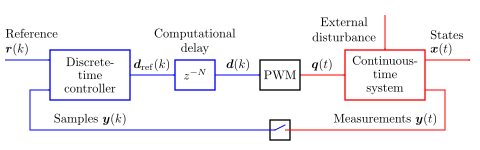
Block diagram of a sampled-data system. Discrete signals and systems are shown in blue, and continuous signals and systems are shown in red.#
The continuous-time system (named mdl in Examples) is the model of a physical grid-converter system, typically consisting of a power converter, grid, and filter, such as an LCL filter, between the converter and the grid. The continuous-time system may have external inputs, such as a power fed to a DC-bus of the converter.
The discrete-time controller (named ctrl) contains control algorithms, such as current control and DC-bus voltage control. The reference signals could be, e.g., the voltage and power references. The feedback signal \(\boldsymbol{y}(k)\) typically contains the measured DC-bus voltage and converter currents.
Digital control systems typically have a computational delay of one sampling
period, \(N=1\). The PWM block shown in the figure models the carrier
comparison, see more details in Converters. The carrier comparison is
implemented in the class gritulator.model.CarrierComparison. If the
switching ripple is not of interest in simulations, the carrier comparison can
be replaced with zero-order hold (ZOH).
References