Note
Go to the end to download the full example code.
2.6-kW bearingless SyRM, levitation control#
This example simulates levitation control of a 2.6-kW six-phase bearingless synchronous reluctance machine (SyRM) drive. The rotor is a point mass, whose radial position is controlled by means of state feedback with a disturbance observer. The levitation controller gives the radial force reference to the direct force controller [1]. The machine and the controller use the same constant parameters, i.e., magnetic saturation and the unbalanced magnetic pull are omitted, while the inductances depend linearly on the displacement.
from math import pi

from motulator_bearingless import control, model, utils
Compute base values based on the nominal values (just for figures).
nom = utils.NominalValues(U=220, I=12, f=50, P=2.6e3, tau=14.5)
base = utils.BaseValues.from_nominal(nom, n_p=2)
Configure the system model. The machine parameters are those of the direct force control example. The rotor mass roughly corresponds to the rotor lamination and the shaft inside it.
par = model.BearinglessSynchronousMachinePars(
    R_s=0.215, L_1=0.03, L_d=0.03, L_q=0.01, m_d=10.0, m_q=0.2
)
m = 20.0
machine = model.BearinglessSynchronousMachine(par)
w_M_rated = 2 * pi * 1700 / 60
k = nom.tau / w_M_rated**2  # Quadratic load torque, rated torque at the rated speed
mechanics = model.MechanicalSystem(J=0.05, B_L=lambda w_M: k * abs(w_M))
radial = model.RadialMechanics(m=m)
converter = model.MultiThreePhaseConverter(u_dc=540)
sensors = model.BearinglessDriveSensors(w_M=model.Sensor(), theta_M=model.Sensor())
mdl = model.BearinglessDrive(machine, mechanics, radial, converter, sensors)
Configure the control system. The observer of the levitation controller is driven by the radial force estimate, so its poles can be placed above the displacement-control bandwidth without considering the dynamics of the inner force control loop.
cfg = control.DirectForceControllerCfg(i_s_max=1.5 * base.i, psi_s_min=0.3)
force_ctrl = control.DirectForceController(par, cfg)
speed_ctrl = control.SpeedController(J=0.05, alpha_s=2 * pi * 4)
levitation_ctrl = control.LevitationController(
    m=m, alpha_q=2 * pi * 50, alpha_o=2 * pi * 150
)
ctrl = control.DirectForceControlSystem(force_ctrl, speed_ctrl, levitation_ctrl)
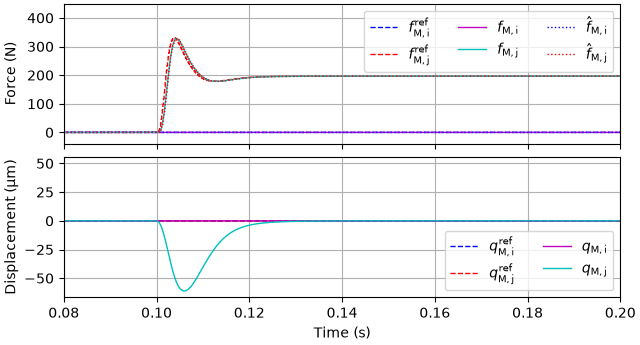
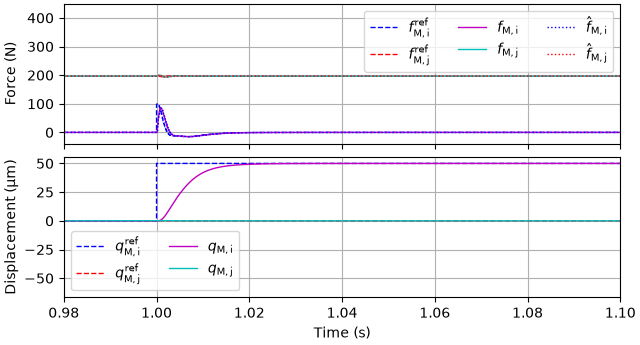
Set the references and the external force. The machine is magnetized during the first 0.2 s, after which the rotor is accelerated to the rated speed of 1700 r/min in 0.6 s against the quadratic load torque. The gravity is applied as a step at t = 0.1 s in the negative direction of the j axis, and a displacement reference step of 50 µm at t = 1 s.
ctrl.set_speed_ref(lambda t: min(max(t - 0.2, 0) / 0.6, 1) * w_M_rated)
ctrl.set_displacement_ref(lambda t: (t > 1) * 50e-6)
radial.set_external_force(lambda t: (t > 0.1) * -9.81j * radial.m)
Create the simulation object, simulate, and plot the results.
sim = model.Simulation(mdl, ctrl)
res = sim.simulate(t_stop=1.2)
subplots = ["speed", "torque", "force", "displacement", "current"]
f_lims = (-40.0, 450.0)  # Room for the legends
utils.plot(
    res, base, subplots, y_lims=[None, (-0.05, 1.625), f_lims, None, (-1.3, 0.95)]
)
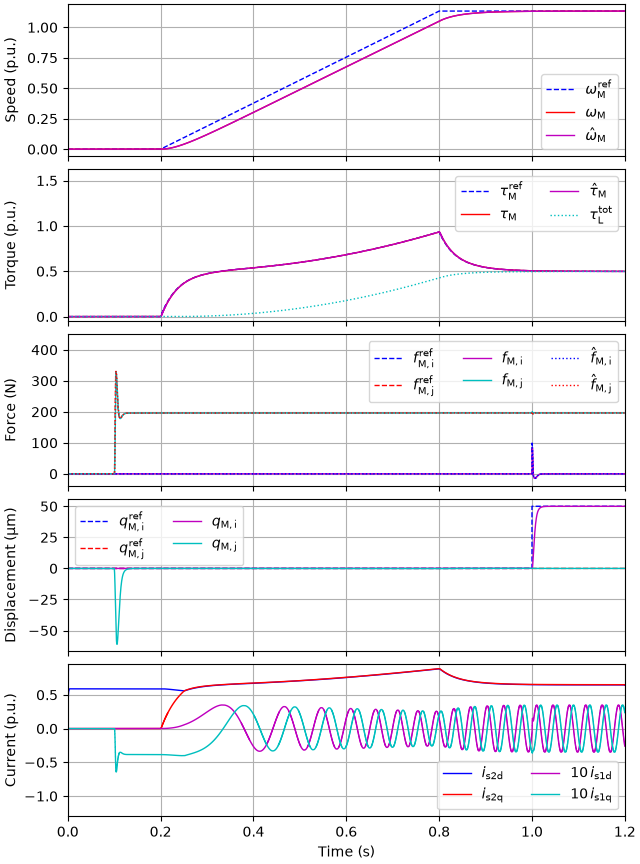
Plot the response to the gravity step and to the displacement reference step.
utils.plot(res, base, ["force", "displacement"], t_lims=(0.08, 0.2), y_lims=[f_lims])
utils.plot(res, base, ["force", "displacement"], t_lims=(0.98, 1.1), y_lims=[f_lims])
References
Total running time of the script: (0 minutes 22.607 seconds)