Note
Go to the end to download the full example code.
2.6-kW bearingless SyRM, comparison of control models in levitation control#
This example compares two parametrizations of the direct force controller [1] in the levitation control of a 2.6-kW six-phase bearingless synchronous reluctance machine (SyRM). The machine model is a GradNet current map with the spatial harmonics. The controller uses either constant parameters, computed at the rated peak current, or a GradNet flux map. The rotor runs at the rated speed, driven externally.
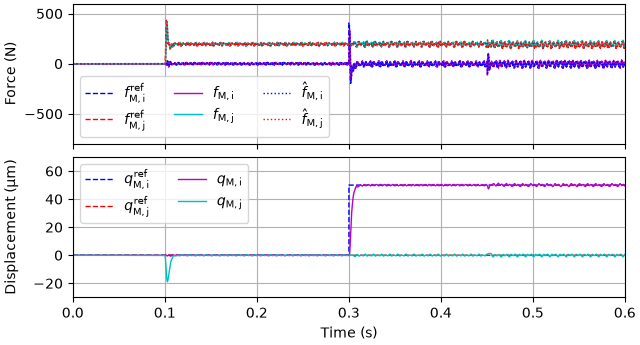
The unbalanced magnetic pull is a negative stiffness in the radial dynamics. The force estimate of the flux map includes it, while that of the constant-parameter model omits it, leaving the pull for the disturbance observer of the levitation controller.
Compute base values based on the nominal values (just for figures).
nom = utils.NominalValues(U=220, I=12, f=50, P=2.6e3, tau=14.5)
base = utils.BaseValues.from_nominal(nom, n_p=2)
Load the magnetic models and compute the stiffness of the unbalanced magnetic pull from the force map at constant currents. The rotor mass is that of the levitation examples.
p = Path(__file__).resolve().parent if "__file__" in globals() else Path.cwd()
R_s = 0.215  # Stator resistance from [#Das2026]_
path = "trained_models/bsyrm_fem_curr_map_harm_softmax_d128.npz"
current_map = gn.CurrentMapWithHarmonics(gn.load_gradnet(p / path))
par = model.SpatialSaturatedBearinglessSynchronousMachinePars(R_s, current_map)

path = "trained_models/bsyrm_fem_flux_map_softmax_d128.npz"
est_flux_map = gn.FluxMap(gn.load_gradnet(p / path))
est_par = control.SaturatedBearinglessSynchronousMachinePars(
    R_s, psi_s_fcn=est_flux_map
)
est_par_lin = est_par.linearized(12 + 12j)
m = 20.0
for i_s2 in (13.5 + 0j, 12 + 12j):
    k_u = np.real(est_par.f_M(0j, i_s2, 1e-6))  # Force (N) at the displacement of 1 µm
    print(f"Stiffness of the pull at i_s2 = {i_s2} A: {k_u:.1f} N/µm")
Stiffness of the pull at i_s2 = (13.5+0j) A: 6.1 N/µm
Stiffness of the pull at i_s2 = (12+12j) A: 4.2 N/µm
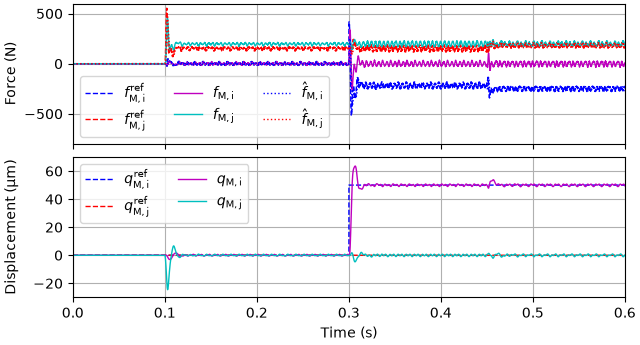
Configure the simulation. Without the pull in the force estimate, the stability of the displacement control is limited. For one axis in continuous time, an ideal inner force control loop, and alpha_o = 3*alpha_q, the closed-loop poles stay in the left half-plane only if the stiffness is below 1.39*m*alpha_q**2. The limit is 2.75 N/µm at the bandwidth of 50 Hz and 11 N/µm at the bandwidth of 100 Hz used here. The constant-parameter controller would hence be unstable at 50 Hz, unlike the flux map.
alpha_q = 2 * pi * 100
w_M_rated = 2 * pi * 1700 / 60
t_stop = 0.6


def simulate(par_c: control.BearinglessMagneticModel):
    """Simulate the drive with the given control model."""
    machine = model.BearinglessSynchronousMachine(par)
    mechanics = model.ExternalRotorSpeed()
    mechanics.set_external_rotor_speed(w_M_rated)
    radial = model.RadialMechanics(m=m)
    radial.set_external_force(lambda t: (t > 0.1) * -9.81j * m)
    converter = model.MultiThreePhaseConverter(u_dc=540)
    sensors = model.BearinglessDriveSensors(w_M=model.Sensor(), theta_M=model.Sensor())
    mdl = model.BearinglessDrive(machine, mechanics, radial, converter, sensors)
    cfg = control.DirectForceControllerCfg(i_s_max=25.5, psi_s_min=0.4)
    force_ctrl = control.DirectForceController(par_c, cfg)
    levitation_ctrl = control.LevitationController(m=m, alpha_q=alpha_q)
    ctrl = control.DirectForceControlSystem(force_ctrl, None, levitation_ctrl)
    ctrl.set_torque_ref(lambda t: (t > 0.45) * 0.7 * nom.tau)
    ctrl.set_displacement_ref(lambda t: (t > 0.3) * 50e-6)
    return model.Simulation(mdl, ctrl).simulate(t_stop=t_stop)


res_lin = simulate(est_par_lin)
res_map = simulate(est_par)
for name, res in (("Constant parameters", res_lin), ("Flux map", res_map)):
    q_M_ab = res.mdl.machine.q_M_ab
    print(
        f"{name}: peak displacement {1e6 * np.max(np.abs(q_M_ab)):.1f} µm, "
        f"final displacement {1e6 * np.mean(q_M_ab[res.mdl.t > 0.55]):.1f} µm"
    )
Constant parameters: peak displacement 63.8 µm, final displacement 50.0-0.0j µm
Flux map: peak displacement 51.3 µm, final displacement 50.0-0.0j µm
Plot the results of the constant-parameter controller. Gravity is applied at t = 0.1 s, the displacement reference step at t = 0.3 s, and the torque reference step at t = 0.45 s.
Plot the results of the flux-map controller.
utils.plot(res_map, base, ["force", "displacement"], y_lims=y_lims)
References
Total running time of the script: (0 minutes 25.782 seconds)